If One Was Going to Decorate Their Renasiannce Villa What Are the 3 Major Art Forms They Would Use
Chartreuse de Champmol
The Chartreuse de Champmol, a Carthusian monastery on the outskirts of Dijon, represents the finest monumental piece of work of early on mod France.
Learning Objectives
Discuss how the Carthusian monastery Chartreuse de Champmol became "the grandest project in a reign renowned for extravagance" under the Valois dynasty of Burgundy
Central Takeaways
Key Points
- Champmol was intended to rival Cîteaux, Saint-Denis, where the Kings of French republic were cached, and other dynastic burial places.
- Champmol was lavishly enriched with works of fine art, and the dispersed remnants of its drove remain fundamental to the understanding of the art of the menses.
- The monastery was founded in 1383 by Duke Philip the Bold to provide a dynastic burial identify for the Valois Dukes of Burgundy, and operated until it was dissolved in 1791, during the French Revolution .
- In 1395, Claes Sluter began work on the Well of Moses, which combines International Gothic with northern realism . Still, the monumentality of the sculptures is unprecedented in either style .
- The interior of the church features the elaborate tombs of John the Fearless and Margaret of Bavaria, each of which is supported past a sculpture group of pleurants (mourners) whose expressions of grief are unprecedented for their time.
Key Terms
- Carthusian monastery: The building, or complex of buildings, comprising the domestic quarters and workplace(s) of monastics, whether monks or nuns, and whether living in customs or alone (hermits). The monastery generally includes a place reserved for prayer, which may be a chapel, church or temple, and may also serve as an oratory.
- Valois: A cadet branch of the Capetian dynasty, succeeding the House of Capet (or "Direct Capetians") as kings of France from 1328 to 1589. A cadet branch of the family reigned every bit dukes of Burgundy from 1363 to 1482. They were descendants of Charles of Valois, the 4th son of Male monarch Philip Three. They based their claim on the Salic constabulary, which excluded females (Joan II of Navarre) also as male descendants through the distaff line (Edward Iii of England), from the succession to the French throne.
Monastic Splendor
The Chartreuse de Champmol, formally the Chartreuse de la Sainte-Trinité de Champmol, was a Carthusian monastery on the outskirts of Dijon, which is at present in France, but in the 15th century was the capital letter of the and then-independent Duchy of Burgundy. The monastery was founded in 1383, past Duke Philip the Bold, to provide a dynastic burial place for the Valois Dukes of Burgundy, and operated until it was dissolved in 1791, during the French Revolution. It was lavishly enriched with works of art, and the dispersed remnants of its drove remain primal to the understanding of the art of the period. Champmol was intended to rival Cîteaux, Saint-Denis, where the Kings of France were buried, and other dynastic burying places.
Purchase of the land and quarrying of materials began in 1377, but construction did non begin until 1383, nether the architect Druet de Dammartin from Paris, who had previously designed the Duke's chateau at Sluis, and worked equally an banana in the construction of the Louvre. A committee of counselors from Dijon supervised the construction for the ofttimes absent Duke. Past 1388 the nearly completed church was consecrated. Claes Sluter and his workshop produced sculptures of Philip and his wife kneeling in prayer toward the key sculpture of the Madonna and Child for the church building's master portal .

Claes Sluter. West portal of the church: Sculptures of Philip the Bold (left) and his wife (right) kneeling earlier the Madonna and Kid.
The monastery was congenital for 24 choir monks, instead of the usual 12 in a Carthusian house. Its cloister surrounded a courtyard in which Sluter synthetic the Well of Moses (1395–1403), whose awe-inspiring sculptures combine the International Gothic mode with a northern realism. Their scale, nonetheless, is unprecedented in either way. The figures range from the namesake of the well to Old Attestation prophets to the Crucifixion. Although information technology was intended to function as a fountain, the water feature was abandoned and so as not to conflict with the monks' vow of silence.

Claes Sluter. Well of Moses: The base of the Well of Moses shows the prophets who foretold the coming of Christ.
In 1433, ii more monks were endowed to celebrate the birth of Charles the Bold. These lived semi-hermitic lives in their private small houses when not in the chapel. Other inhabitants of the monastery included non-ordained monks, servants, novices, and other workers.

Champmol in 1686: This drawing shows the cottage-like hermitages of the monks surrounding the main cloister, with the Well of Moses in the middle.
A Ducal Symbol
Somewhat in contradiction to the Carthusian mission of tranquil contemplation, the monastery welcomed visitors and pilgrims. The expenses of hospitality were then recompensed by the Dukes. In 1418, Papal indulgences were granted to those visiting the Well of Moses, further encouraging pilgrims. The Ducal family had a private oratory overlooking the church, which has since been destroyed, though their visits were in fact rare. Ducal accounts prove major commissions for paintings and other works to complete the monastery continuing until about 1415. Further works were later added by the Dukes and other donors, although building progressed at a slower rate.
The Valois dynasty of Burgundy had less than a century to run when the monastery was founded. The number of Valois tombs never approached that of their Capetian predecessors at Cîteaux, as the choir of the church was not large enough to suit them. Only two monuments were ever erected, both in the aforementioned fashion, with painted alabaster effigies with lions at their feet and angels with spread wings at their heads. Underneath the slab on which the effigies rested, small unpainted pleurants (mourners) were set among Gothic tracery . They were, at the time of their product, the most moving representations of grief conveyed in a sculptural medium .
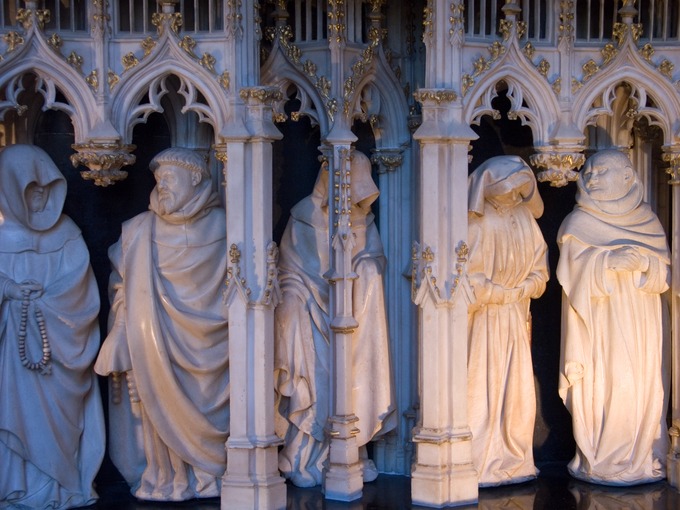
Pleurants (Mourners): Rock mourners at a tomb in Chartreuse de Champmol. Approximately 40 cm high.
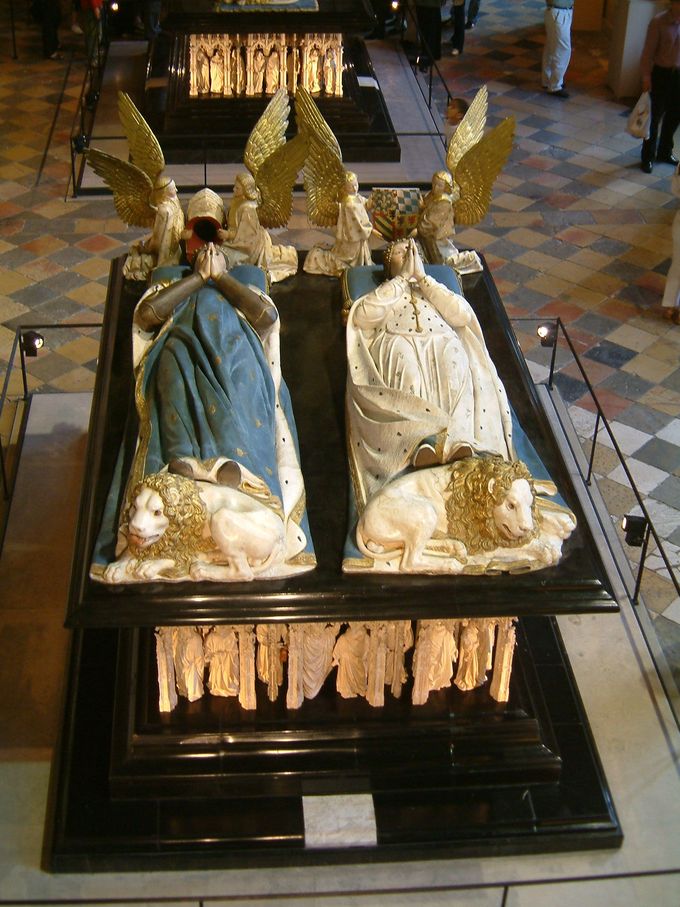
Tomb of John the Fearless and Margaret of Bavaria: John the Fearless commissioned work on this tomb, though by his death in 1419, nothing had been washed. The project saw several different artists at work until its completion in 1470.
Champmol was designed as a showpiece. The artistic contents, now dispersed, represent much of the finest awe-inspiring work of French and Burgundian fine art of the period, demonstrating a tradition distinct from that of the similarly prestigious illuminated manuscripts .
French Compages in the Northern Renaissance
Francis I (1515–1547) brought almost such huge cultural changes in French republic that he has been chosen France's original Renaissance monarch.
Learning Objectives
Talk over the advancements in architecture as seen under the reign of Francis I
Primal Takeaways
Key Points
- At the fourth dimension of the accession of Francis I, the purple palaces of French republic were ornamented with only a scattering of great paintings and devoid of sculpture. During his reign, the magnificent art collection of the French kings was begun.
- Francis poured vast amounts of money into new structures. He continued the work of his predecessors on the Château d'Amboise and likewise started renovations on the Château de Blois. Early in his reign, he besides began construction of the magnificent Château de Chambord.
- Non a castle in the traditional military sense, the Château de Chambord was built as a hunting order for the rex and contains unique architectural elements, such as towers without turrets and a double spiral staircase that extends through 3 stories.
- The largest edifice project under Francis's reign was at the Palace of Fontainebleau, where, it is said, the French Renaissance began.
- Francis employed some of the most famous artists from Europe to decorate Fontainebleau. They included Rosso Fiorentino, Francesco Primaticcio, and Benvenuto Cellini. Cellini designed the famous Nymphe de Fontainebleau.
Primal Terms
- patron: An influential, wealthy person who supports an artist, craftsman, scholar, or aristocrat.
- château: French castle, fortress, manor firm, or large country house.
Francis I: Patron of the Arts
Francis I (1494–1547) was Rex of France from 1515 until his death. During his reign, huge cultural changes took place in France. He has been called France's original Renaissance monarch. By the time he ascended the throne in 1515, the Renaissance had arrived in France, and Francis became a major patron of the arts. At the time of his accretion, the royal palaces were ornamented with only a handful of great paintings and no sculptures. During Francis'due south reign, the magnificent art collection of the French kings, which can still be seen at the Louvre, was begun.
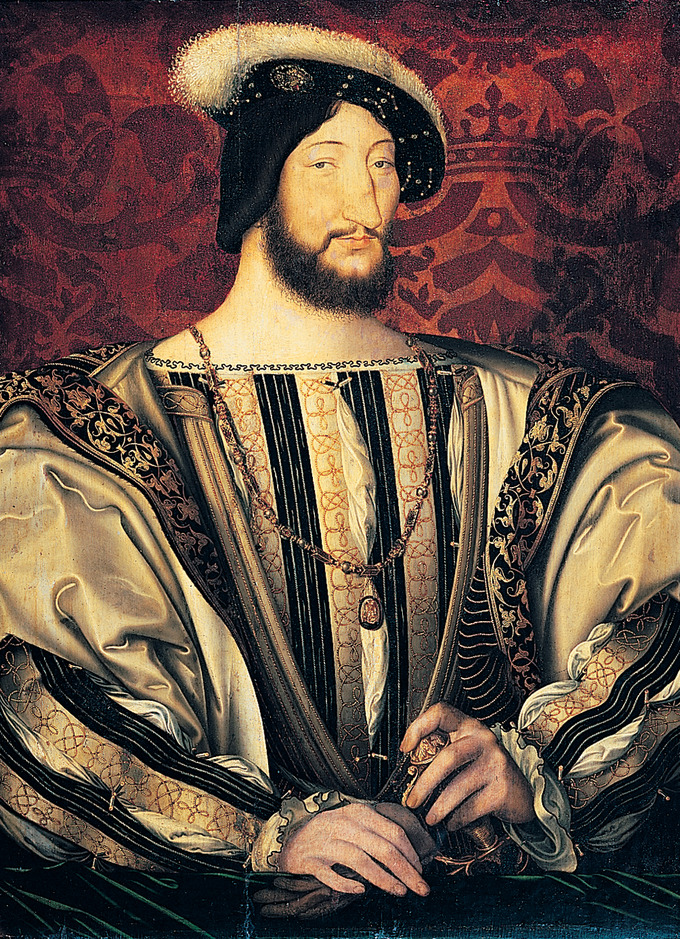
Francis I past Jean Clouet (circa 1530): Portrait of Francis I. He was one of the cracking patrons of the arts in early modern Europe.
Francis poured vast amounts of money into new structures. He continued the piece of work of his predecessors on the Château d'Amboise and also started renovations on the Château de Blois. Early in his reign, he began construction of the magnificent Château de Chambord, inspired by the styles of the Italian Renaissance and perhaps fifty-fifty designed by Leonardo da Vinci. Francis rebuilt the Château du Louvre, transforming it from a medieval fortress into a edifice of Renaissance splendor. He financed the edifice of a new Metropolis Hall (Hôtel de Ville) for Paris in order to have command over the edifice's blueprint. He constructed the Château de Madrid in the Bois de Boulogne and rebuilt the Château de St-Germain-en-Laye.
Châteaux in the 16th century departed from castle architecture. While they were offshoots of castles, with features unremarkably associated with them, they did non accept serious defenses. Extensive gardens and water features, such every bit a moat, were common amongst châteaux from this menses.
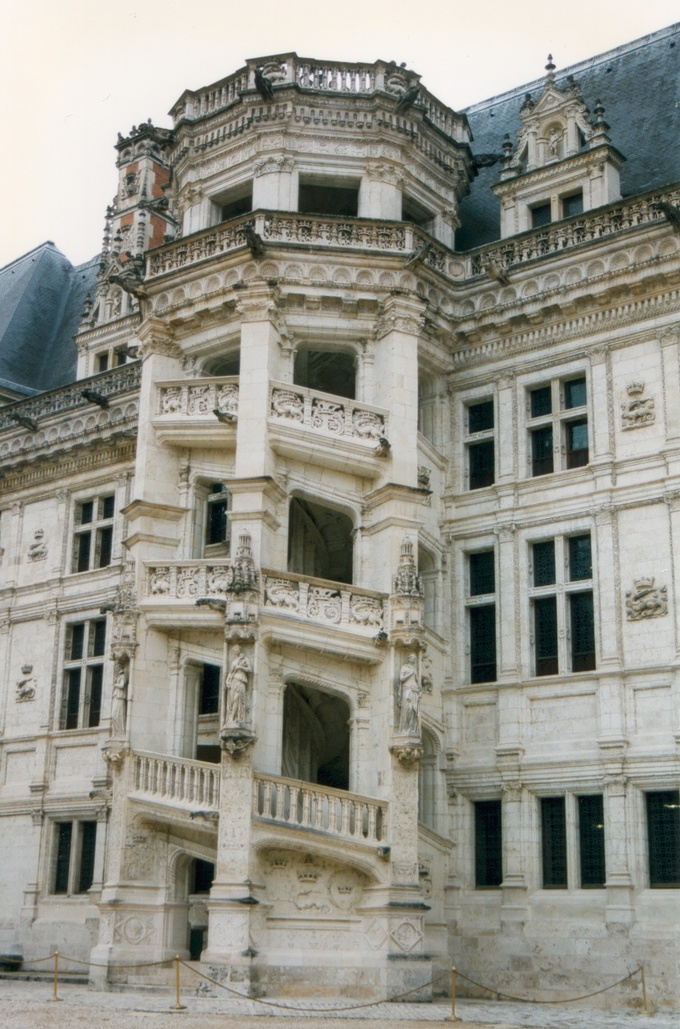
The Francis I wing of the Chateau de Blois: The Château de Blois'southward spiral staircase is one of the peachy artistic achievements of the French Renaissance under Francis I.
Château de Chambord

Château de Chambord, northwest façade: The Château de Chambord is an instance of Renaissance architecture and is the largest castle of the Loire valley, measuring 156 meters long and topping 56 meters high.
Chambord is the largest château in the Loire Valley. Information technology was built primarily as the rex'south hunting lodge. The layout is reminiscent of a typical castle with a keep , corner towers, and defended by a moat. Built in Renaissance style, the internal layout is an early on example of the French and Italian style of grouping rooms into cocky-contained suites, a deviation from the medieval style of corridor rooms. The massive château is composed of a central keep with four immense breastwork towers at the corners. The continue as well forms office of the front wall of a larger compound with two more large towers. Bases for a possible further ii towers are found at the rear, but these were never developed, and remain the aforementioned acme every bit the wall. The château features 440 rooms, 282 fireplaces, and 84 staircases. Iv rectangular vaulted hallways on each floor form a cantankerous shape.
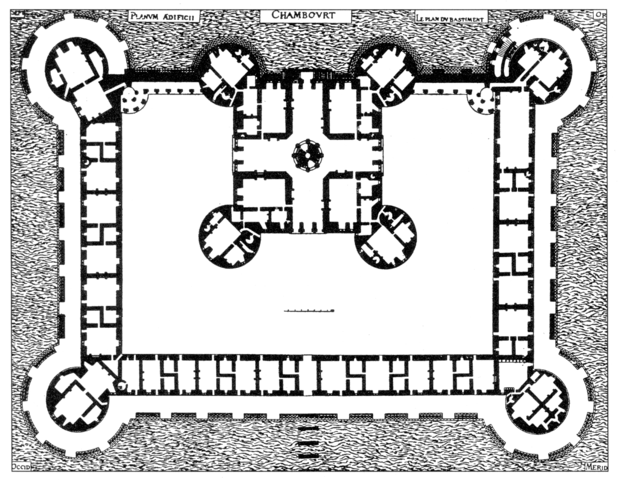
Château de Chambord, plan: Plan of the château as engraved past Jacques Androuet du Cerceau (1576).
Like the Château de Blois, i of Chambord'due south architectural highlights is the spectacular open double screw staircase. The two spirals ascend the 3 floors without ever coming together, illuminated from above by a sort of lighthouse at the highest signal of the château.

Château de Chambord, double spiral staircase: The staircase extends upward through 3 stories.
Château of Fontainebleau
The largest of Francis's building projects was the reconstruction and expansion of the imperial Château of Fontainebleau, which rapidly became his favorite place of residence, likewise every bit the residence of his official mistress (Anne, Duchess of Étampes). He commissioned the architect Gilles le Breton to build a château in the new Renaissance style. Le Breton preserved the former medieval donjon, where the king's apartments were located, but incorporated information technology into the new Renaissance style Cour Ovale (Oval Courtyard), congenital on the foundations of the old castle. It included awe-inspiring Porte Dorée (Golden Door), the main archway, every bit its southern entrance, as well as a awe-inspiring Renaissance stairway, the portique de Serlio, to give admission the royal apartments on the northward side.

Gilles Le Breton. Cour Ovale. Château of Fontainebleau: The Oval Courtyard, with the Medieval donjon, a vestige of the original castle where the king's apartments were located, in the middle.
Showtime in approximately 1528, Francis synthetic the Gallery Francis I, which allowed him to pass direct from his apartments to the chapel of the Trinitaires. He brought the architect Sebastiano Serlio from Italy, and the Florentine painter Giovanni Battista di Jacopo, known as Rosso Fiorentino, to decorate the new gallery. Between 1533 and 1539 Rosso Fiorentino filled the gallery with murals glorifying the king, framed in stucco ornamentation in high relief , and lambris sculpted by the piece of furniture maker Francesco Scibec da Carpi. Another Italian painter, Francesco Primaticcio from Bologna, joined later in the decoration of the château. Together their style of decoration became known as the offset School of Fontainebleau. This was the first keen decorated gallery built in France. Broadly speaking, at Fontainebleau the Renaissance was introduced to France.

Sebastiano Serlio and Rosso Fiorentino. Gallery of Francis I: The Gallery of Francis I, connecting the male monarch'southward apartments with the chapel, decorated between 1533 and 1539. Information technology introduced the Italian Renaissance style to France.
Each of Francis's projects was luxuriously busy, both inside and out. Fontainebleau, for instance, had a gushing fountain in its courtyard where quantities of wine were mixed with the h2o. The fountain was linked to a legend related to i of the all-time known projects for the château.
Among the almost striking works of art within Fontainebleau was the Nymphe de Fontainebleau (1542) by the Italian sculptor Benvenuto Cellini. Francis commissioned this large-scale bronze bas relief , cast in the lost wax process, equally the tympanum to sit atop the Porte Dorée. In the sculpture, a Mannerist nude nymph reclines among woodland animals, such as deer and boars. The central buck, wearing a garland of fruit, symbolizes Francis's ability. Equally a whole the sculpture is based on a legend in which a hunting dog discovered a spring personified by a nymph learning against an urn . It was this bound that gave the château and surrounding environment the name Fontainebleau. The tympanum was to be flanked on either side by bronze sculptures of nude satyrs , posed as mirror images of one another, also bandage by Cellini. Somewhen, the project was abased, and the nymph was integrated into the design of an aristocrat'south palace 10 years subsequently.

Benvenuto Cellini, Nymphe de Fontainebleau: Statuary. 1542. Musée du Louvre, Paris.
Spanish Architecture in the Northern Renaissance
Gothic, Renaissance, and Mannerist elements are all important to the architecture of Spain in the 16th century.
Learning Objectives
Examine the influence of Gothic, Renaissance, and Mannerist elements in the architecture of Spain in the 16th century
Key Takeaways
Key Points
- Plateresque emerged in Kingdom of spain in the belatedly 15th century. This architectural style , named for silversmiths, was known for producing decorative façades suggestive of argent plate.
- From the mid 16th century, Castilian architecture adhered closely to the fine art of ancient Rome , anticipating Mannerism .
- The Herrerian style dominated Spain in the late 16th and 17th centuries and was divers by clean and sober façades and attention to geometrical precision.
- El Escorial is a well-known example of the Herrerian way with its ascetic façades and fortress-like appearance.
Key Terms
- Herrerian: A 16th century Spanish mode characterized past geometric rigor, clean volumes, the say-so of the wall over the span, and the almost total absence of ornamentation.
- plateresque: Pertaining to an ornate fashion of architecture of 16th century Spain suggestive of silverish plate.
Renaissance architecture reached the Iberian peninsula in the 16th century, ushering in a new manner that gradually replaced the Gothic architecture , which had been pop for the centuries.
Gothic forms began to incorporate the classical style of the Renaissance in the last decades of the 15th century. Local architects developed a specifically Spanish Renaissance, bringing the influence of South Italian architecture, sometimes from illuminated books and paintings, mixed with Gothic tradition and local traditions. The new mode was chosen Plateresque considering of the extremely decorated façades that brought to the heed the decorative motifs of the intricately detailed work of silversmiths, the "Plateros." Ornamentation included floral designs, chandeliers, festoons, fantastic creatures, and similar configurations. The spatial organization of Plateresque, still, is more clearly Gothic-inspired. This fixation on specific parts and their spacing, without structural changes of the Gothic pattern, causes it to be frequently classified as simply a variation of Renaissance mode. A prime example of this decorative mode tin be seen in the façade of the University of Salamanca.

University of Salamanca façade: The ornate façade of the University of Salamanca is a prime example of the Plateresque style.
From the mid 16th century, under architects such as Pedro Machuca, Juan Bautista de Toledo, and Juan de Herrera, there was a much closer adherence to the art of ancient Rome, sometimes anticipating Mannerism. An instance of this is the palace of Charles Five in Granada built by Pedro Machuca.
A new style emerged in Espana with the work of Juan Bautista de Toledo and Juan de Herrera in El Escorial, known as the Herrerian style. Herrerian architecture was extremely sober, naked, and particularly accomplished in the use of granite ashlar work. This style influenced the Spanish compages of both the peninsula and the colonies for over a century.
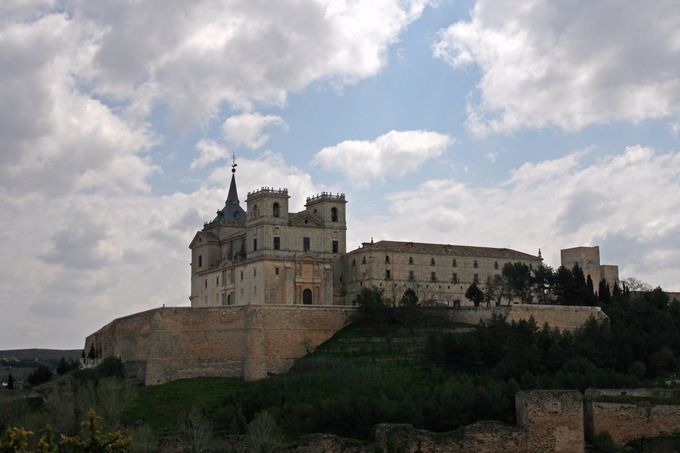
Monasterio de Uclés, Cuenca, España: The Monastery of Uclés is a prime number example of Herrerian architecture.
The flooring plan of El Escorial—a palace for the royal family, monastery for their clergy, and burying identify for major Spanish monarchs—was designed in the form of a gridiron. It was a blueprint whose origin remains a matter of argue.

El Escorial, programme: The gridiron design of the flooring plan of El Escorial has a modular plan, as seen in medieval cathedrals, and geometric symmetry, as seen in classical compages.
Regardless of the reasons behind the floor program, its basic components, equally well equally the full general outside and main façade, adjust to the thrift of the Herrerian style, making the structure appear more like a fortress than a palace or monastery. Information technology takes the course of a gigantic quadrangle, which encloses a series of intersecting passageways and courtyards and chambers. At each of the four corners is a foursquare belfry surmounted by a spire and nigh the eye of the complex ascent the pointed belfries and round dome of the basilica , which are and taller than the rest. As overseer of the construction of El Escorial, Philip II instructed his architects to maintain a sense of simplicity.

Aerial view of El Escorial: The compound of El Escorial contains features that conform to the thrift of Renaissance architecture throughout Europe while likewise anticipating the Baroque era.
The thrift of the west façade of El Escorial is typical of the classicism that re-emerged during the Renaissance. However, the principal archway, which takes the form of classical temple façades stacked atop another, actually looks frontwards to an architectural design that would become mutual during the Baroque era throughout Europe.

Monastery of St. Lawrence, El Escorial, chief façade: The double temple façade contains engaged, as opposed to free-continuing, columns in the Doric and Ionic orders.
English language Architecture in the Northern Renaissance
The Tudor architectural style was the concluding evolution of medieval architecture during the Tudor menstruation (1485–1603).
Learning Objectives
Describe the key elements of the Tudor architectural way, including the Tudor curvation, oriel windows, and the chimney stack
Primal Takeaways
Central Points
- Tudor architecture followed the Perpendicular style and, although superseded by Elizabethan architecture in the domestic building of any pretensions to fashion, the Tudor manner still retained its concord on English taste.
- The iv-centered arch , now known equally the Tudor curvation , was a defining characteristic of the menstruum. Information technology was ofttimes used in the construction of large lancet style windows.
- Another mutual feature of Tudor compages was the oriel window and the jetty , both divers by their projection from the primary office of the building.
- During this catamenia, the inflow of the chimney stack and enclosed hearths resulted in the decline of the corking hall based around an open hearth, which was typical of before medieval compages.
- During the Tudor era, houses and buildings of ordinary people were typically timber -framed, the frame commonly filled with wattle and daub just occasionally with brick.
Key Terms
- Perpendicular style: The third historical division of English Gothic architecture, then called because of its accent on vertical lines.
- Tudor arch: Low and wide with a pointed apex, much wider than its acme and appearing to have been flattened under pressure level.
- jetty: A building technique used in medieval timber-frame buildings in which an upper floor projects beyond the dimensions of the floor beneath.
- oriel: A class of bay window that projects from the principal wall of a edifice simply does not reach to the ground.
- Elizabethan: Pertaining to the reign of first female monarch of England.
The Tudor architectural style was the terminal evolution of medieval compages during the Tudor period (1485–1603), and fifty-fifty beyond, for conservative college patrons . The designation "Tudor style" is an awkward one, with its implied suggestions of continuity through the menses of the Tudor dynasty and the misleading impression that there was a way pause at the accession of Stuart James I in 1603. Information technology followed the Perpendicular style and, although superseded by Elizabethan architecture in the domestic building of any pretensions to style, the Tudor way withal retained its hold on English gustation. Portions of the additions to the various colleges of Oxford University and Cambridge University were however being carried out in the Tudor style, which overlaps with the first stirrings of the Gothic Revival.
The Tudor arch, a low and wide blazon of arch with a pointed apex , was a defining feature of the menses. It is much wider than its acme and gives the visual issue of having been flattened under pressure. This blazon of arch, when employed equally a window opening, lends itself to very wide spaces , as seen in the chapel window of King's College at Cambridge University.

Male monarch'due south Higher chapel, University of Cambridge: The chapel at King'southward College of the University of Cambridge is one of the finest examples of late Gothic (Perpendicular) English architecture, while its early Renaissance rood screen (separating the nave and chancel), erected in 1532–36 in a hitting contrast of style, shows the influence of compages from the Italian peninsula.
Some of the well-nigh remarkable oriel windows belong to this catamenia. An example can be seen in the Priory Church building of St. Bartholomew the Great in London. The oriel window was installed inside St. Bartholomew the Great in the early 16th century past Prior William Bolton, allegedly so that he could keep an eye on the monks. The symbol in the centre panel is a crossbow "commodities" passing through a "tun" (or barrel), a pun on the name of the prior.

Oriel window, Priory Church of St. Bartholomew the Great: Early on 16th century London.
During this period, the arrival of the chimney stack and enclosed hearths resulted in the decline of the neat hall based around an open up hearth, which was typical of earlier medieval architecture. Instead, fireplaces could now exist placed upstairs, and information technology became possible to accept a second story that ran the whole length of the business firm. Tudor chimney pieces were fabricated big and elaborate to draw attending to the owner's adoption of this new technology. The jetty appeared as a way to testify off the modernity of having a complete, total-length upper floor.

Piffling Moreton Hall: Little Moreton Hall, constructed in the mid 16th century, is an example of a Tudor way timber-frame house with a chimney stack and a jettied second floor visible from the exterior.
The style of large houses moved away from the defensive architecture of earlier moated manor houses, and instead began emphasizing aesthetics . For example, quadrangular ('H' or 'E' shaped plans) became more common. It was also stylish for these larger buildings to incorporate "devices," or riddles, designed into the building, which served to demonstrate the owner's wit and to please visitors. Occasionally these were Cosmic symbols, for example, subtle or not-so-subtle references to the trinity, seen in 3-sided, triangular, or 'Y' shaped plans, designs, or motifs .
The houses and buildings of ordinary people were typically timber-framed, the frame usually filled with wattle and daub just occasionally with brick. These houses were also slower to adopt the latest trends and the great hall continued to prevail. The Dissolution of the Monasteries provided surplus land, resulting in a small-scale building nail, besides every bit a source of stone.
Anne Hathaway's Cottage is a 12-room farmhouse where the wife of William Shakespeare lived equally a kid in the village of Shottery, Warwickshire, England. As in many houses of the flow, it has multiple chimneys to spread the heat evenly throughout the house during winter. The largest chimney was used for cooking. It besides has visible timber framing, typical of vernacular Tudor architecture.

Anne Hathaway's Cottage: The design of the childhood dwelling house of Anne Hathaway is typical of a house inhabited by commoners in Tudor England.
Source: https://courses.lumenlearning.com/boundless-arthistory/chapter/architecture-of-the-northern-renaissance/
Post a Comment for "If One Was Going to Decorate Their Renasiannce Villa What Are the 3 Major Art Forms They Would Use"